
What 971 Cockpit Dials Taught Us About Simplicity
What happens when a complex product becomes simple — and why calm is not the same as less information.

Imagine you step into the cockpit of a classic Boeing 747. In front of you, above you, and beside you, there are dials, gauges, switches, and knobs. Hundreds of them. A third crew member, the flight engineer, sits with the two pilots to help manage it all.
Now imagine the same job, a few years later, in a newer version of the same aircraft. The cockpit is quieter. The dials are gone. Screens show what matters.
This is not just a story about aviation. It is one of the clearest case studies we have on what happens when a complex product becomes simple.
The numbers behind the calm
The Boeing 747–400 introduced a glass cockpit made for two pilots instead of three. It reduced the number of dials, gauges, and knobs from 971 to 365 by using electronics.
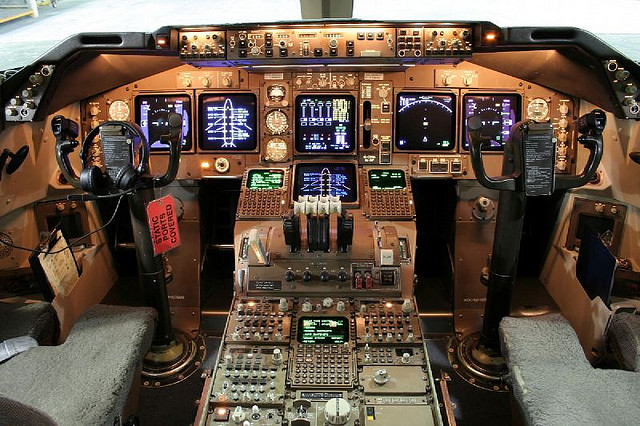 Source: https://commons.wikimedia.org/wiki/File:Boeing_747-400_cockpit.jpg
The change is even easier to feel when you look at emergency procedures. For an engine fire, the dials a crew had to check dropped from 15 to 4. For decompression, they dropped from 20 to 3. For a cargo fire, from 16 to 2. In a stressful moment, this means less searching and more acting.
Behind the scenes, the system changed too. Fourteen computers for flight control were replaced by just three.
A change that took a decade
This did not happen overnight. Boeing introduced a two-crew glass cockpit on its 757 and 767 in 1982, and the 747–400 entered service in 1989. The term “glass cockpit” became common with the Airbus A320 family in the mid-1980s.
Today, this idea is no longer a big change. It is the starting point. Take the Airbus A220, a clean-sheet aircraft that began as Bombardier’s CSeries. Airbus says its cockpit was designed to be simple, cost-effective, and smart. It has large screens, fewer manual controls, and fly-by-wire flight controls. For a new design like this, simplicity is where the work begins.
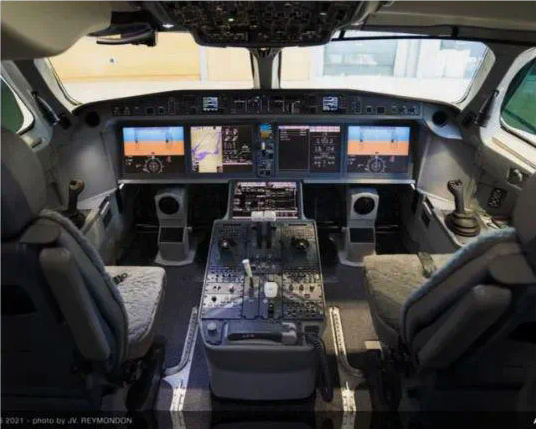 Source: https://www.airbus.com/en/products-services/commercial-aircraft/cockpits
Modern systems also do something very calm-tech: they watch for problems so people do not have to. Alerting systems detect failures and guide the crew through the right actions, which reduces the number of checklists. The system carries the burden of watching, and the pilot keeps attention for decisions.
So, where did the complexity go?
If you read our earlier article about Tesler’s Law, you already know the answer. Complexity does not disappear. It moves.
In the old cockpit, complexity lived on the panel. The crew could see it, touch it, and check it. In the new cockpit, complexity lives inside computers and software. The system decides what to show and when to show it.
This is a great trade in most cases. But it has a price.
The hidden price of a calm interface
When the system does more work, the person does less. That sounds perfect, until the person must step in.
One aviation systems overview notes that safety bodies have identified heavy dependence on automation and weaker manual flying skills as systemic risks. Pilot training is also described as a concern.
Think about what this means. A calm interface can make people feel that everything is fine. But if they cannot see why it is fine, or what the system is doing, they may not be ready when it stops being fine.
That is the real lesson. Calm is not the same as less information. Calm is the right information at the right time.
Three lessons for your product
You may not design cockpits. But if you build B2B software, dashboards, or AI tools, you face the same question. Here are three ideas to take with you:
-
Reduce noise, not visibility.
Hide details by default, but let users ask “why?” at any time. A simple screen should always have a clear path to the deeper layer. -
Make handovers obvious.
When your system takes over a task, changes its mode, or stops working, say it clearly. The most dangerous moment in any automated product is the moment control moves from the system to the person. -
Design for the manual moment.
Ask yourself: what happens when automation is not available? Can your user still understand the situation and act? Test this on purpose. Do not wait for a real emergency to find out.
The better question
For years, design teams have asked, “How little can we show?”
The cockpit teaches us a better question:
“What does this person need to see, right now?”
Fewer dials made pilots’ work calmer. But the best cockpits did not just remove things. They chose carefully what to keep, what to move, and what to bring forward at the right moment. That is the craft of Calm Technology.
References
- Leeham News, “The 747–400 derivative programs apply the lessons” (May 11, 2026): https://leehamnews.com/2026/05/11/the-747-400-derivative-programs-apply-the-lessons/
- AirlineRatings, “How have aircraft cockpits changed over the decades?”: https://www.airlineratings.com/articles/how-have-aircraft-cockpits-changed-over-the-decades
- PlaneFYI, “Glass cockpit system”: https://planefyi.com/zh-hans/systems/glass-cockpit-system/
- Airbus, “A220 airframe & avionics latest features”: https://www.aircraft.airbus.com/en/newsroom/stories/2025-07-the-clean-sheet-single-aisle-aircraft-at-the-vanguard-of-innovation
- Airbus, “Cockpits”: https://www.airbus.com/en/products-services/commercial-aircraft/cockpits