
Why is Calm Tech Missing in Developer Tools?
When we look for calmness in consumer products, why did we surrender our own working tools to noise?
When we look for calmness in consumer products, why did we surrender our own working tools to noise?
The design world has gathered around one single sentence in the last ten years: technology should not steal our attention, it should serve it. The roots of this idea go back to 1995, to the article by Mark Weiser and John Seely Brown at Xerox PARC where they introduced the “calm technology” concept. They argued that technology should solve complexity, not add new complexities. In 2015, Amber Case turned this idea into solid principles: technology should demand the least possible attention, it should communicate information peripherally, and it should come to the center when needed and step back when not.
These principles are often mentioned in the design guidelines of consumer products today. But they still haven’t visited one place: developers’ own tools.
Think about the terminal screen, CI/CD pipeline notifications, monitoring dashboards, and alerts dropping into Slack. These tools are usually kept outside of the calmness principles with the excuse that they are “designed for the professional user.” However, the data says the exact opposite: developers are the group that needs calm design the most, but gets it the least.
The Size of the Problem: Alert Fatigue in Numbers
“Alert fatigue” is now its own research area in DevOps and SRE literature. According to incident.io’s 2025 report, teams get over 2,000 alerts a week, but only about 3% of them really need immediate action. The rest is just background noise that drowns the real signal.
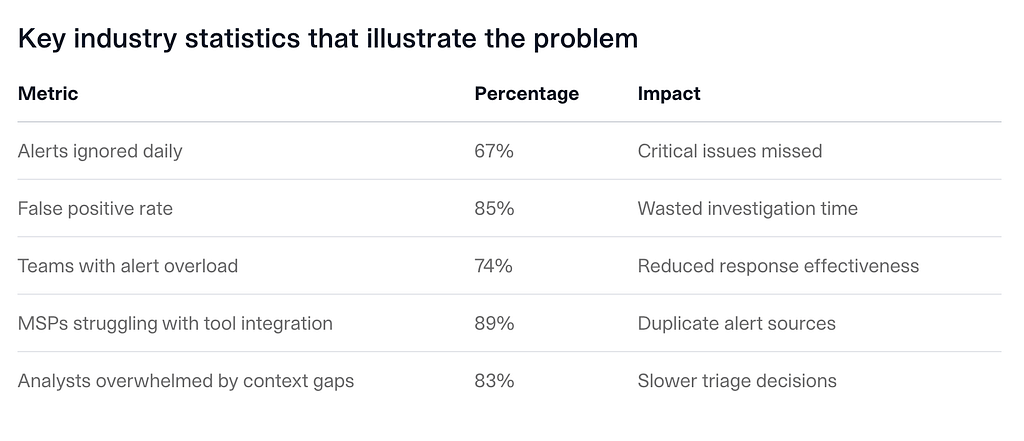 Source: https://incident.io/blog/alert-fatigue-solutions-for-dev-ops-teams-in-2025-what-works
The cost of this situation is not abstract. An analysis published on DevOps.com shows that as cloud infrastructure matures, we face a strange paradox: even though the number of alerts decreases, every remaining alert now requires a higher-risk judgment. As the writers call it, there is a shift from “alert fatigue” to “decision fatigue” — the problem is no longer the volume of notifications, but the cognitive load each notification demands.
There is a similar picture on the academic side. A study titled “Human Factors in DevOps” examines how task fragmentation, constant context switching, and alert fatigue weaken developer effectiveness within the framework of cognitive load theory. It reports that research published in IEEE Software and ACM Queue between 2017–2020 points out that such interruptions have a cumulative cost, increase error rates, and make task completion times longer.
The Real Bill of Context Switching
The most concrete result of developer tools not being calm is constant context switching. Gloria Mark’s observational research from UC Irvine over the years revealed that it takes an average of 23 minutes and 15 seconds to return to full focus after an interruption. This number comes from her studies directly observing knowledge workers (including the 2005 study “No Task Left Behind?”). An earlier finding of the same research series is also striking: a worker can stay in any “working sphere” for only 11 minutes on average before being interrupted.
Mark’s 2023 follow-up data makes the picture even clearer: while an average of 2.5 minutes was spent on one screen in 2004, this time has dropped to just 47 seconds today. For a developer jumping from a terminal window to Slack, from there to a monitoring dashboard, and from there back to the IDE, this means spending most of the day just “refocusing.”
Developer tools do not take this reality into account. Each tool might be well-designed on its own — but for a developer switching between 8–10 different tools daily, the main problem is not the individual interfaces, but the seams between these interfaces. The core of calm technology is the principle of “being able to move to the periphery”; however, the developer ecosystem is a collection of unaware notification sources, each trying to call itself to the center of attention.
Why This Culture Does Not Change?
Three reasons stand out:
- The “Power User” Assumption: Because developers are considered technically competent, they are presented with raw data instead of “simplified” data — as if expertise equals the capacity to handle unlimited cognitive load. However, SoftwareSeni’s article on developer burnout in DevOps shows the exact opposite: a significant part of the time of experienced and expensive engineers is spent struggling with unnecessary (extraneous) cognitive load because of tool flaws. This is a cost that does not improve the infrastructure; it only produces mental fatigue.
- Static Threshold Culture: An analysis published on dev.to argues that the root cause of alert fatigue is static and contextless thresholds like “if X passes 80, send an email.” The author suggests that the industry should shift to contextual, machine learning-supported monitoring. This means the system should send an alert not just when a metric jumps, but if the user is actually affected. But this transition is not widespread yet — most teams still work with the reflex of “log everything, let me know everything.”
- Historical Inertia of the Terminal: An interface that has been working with the same basic interaction model for over fifty years continues to be considered the “most efficient” — because the cost of changing it (muscle memory, script compatibility, learning curve) seems too high. This overlaps with the theme in the article “The Burden of Simplicity”: simplicity makes you pay a price somewhere, and here that price is carried on the developer’s back.
How Do You Know if a Tool is Truly “Calm”?
If we adapt Amber Case’s principles to developer tools, a short checklist emerges:
- Does it show silent success, or does it constantly shout “everything is fine”? A good tool stays in the background in a normal state; it does not send a separate notification for every successful build.
- Does the error message tell you the next step, or does it just spit out a stack trace? There is a big difference between giving information and just pouring information out without organizing it.
- Does the notification distinguish between “needed now” and “can be looked at later”? As incident.io found, if only 3% of alerts really carry urgency, the remaining 97% should come from a different, quieter channel.
- Can the tool appeal to peripheral attention? I mean, can the developer feel the general status (with a simple signal like green or red) without looking directly at that tool, or does every check require active attention?
- Does the tool create the context switch, or does it require a real decision? If a notification pulls you away from your work but does not contain anything actionable, that notification should not be there.
The Main Obstacle is Cultural
The main obstacle to calm technology entering the DevOps world is not technical, it is cultural. The perception of “looking busy = being valuable” causes calm tools to be perceived as “not powerful enough” — as if a dashboard is taken more seriously the more data it shows.
However, the correlation pointed out by SoftwareSeni suggests the exact opposite: as cognitive load decreases, DORA metrics (like deployment frequency, change failure rate) improve. Calmness is not a luxury stolen from productivity; it is the prerequisite for productivity.
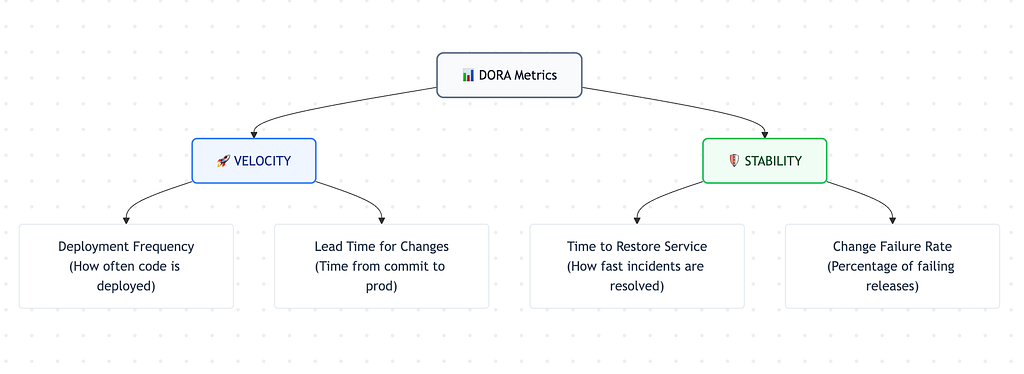 DORA metrics
The answer to the problem is not a new tool. It is the transition of existing tools from the reflex of “show everything” to “show only what is truly needed” — and handling this not as a design choice, but as a strict engineering discipline.
References
- Weiser, M. & Seely Brown, J. (1995). Designing Calm Technology, Xerox PARC.
- Case, A. (2015). Calm Technology: Principles and Patterns for Non-Intrusive Design. O’Reilly Media.
- Mark, G. — UC Irvine, “No Task Left Behind?” (CHI 2005) and related interruption/focus research; Gallup Management Journal (2006) interview.
- Mark, G. (2023). Attention Span.
- incident.io (2025). “Alert fatigue solutions for DevOps teams in 2025: What works.”
- DevOps.com (2026). “How We Got Here: Alert Fatigue to Decision Fatigue.”
- “Human Factors in DevOps: Cognitive Load, Developer Experience, and Team Collaboration” (ResearchGate, 2025).
- SoftwareSeni (2026). “Developer Burnout and Cognitive Load in the DevOps Era.”
- dev.to / Pavan Madduri (2026). “Alert Fatigue is Breaking DevOps: Here is the Math.”