
Why Calm Tech Will Define the Experience of the Future
The future of technology lies in its ability to establish a silent yet deep connection.
 AI-generated image
Every notification, every light, every new feature… Have you noticed the distance between us growing as technology tries to get closer to us? Experience is no longer just about usability; it's about feeling.
People are looking for much more than intuitive interfaces: systems that are comforting, aware yet invisible. The new measure of experience isn't how much attention it captures, but how much peace it provides. Because in our fast-paced daily lives, we truly need a breath of fresh air. Calm Tech is the silent infrastructure of this transformation. The future of experience isn't shaped by blaring technologies, but by technologies that work silently with us.
 AI-generated image
Economy of Attention or Economy of Serenity?
The design language of the last 20 years has been built on the principle of "attention-grabbing." Every color, animation, and sound has targeted the human brain's most basic impulses. But the human mind is not a system suited to constant stimulation, just like trying to sleep with the curtains and windows wide open in a house on a busy street on a sunny day.
The impact of emotional experiences on interactions with technology has been extensively studied in academic research. In this context, Rosalind W. Picard's study in 1995, "Affective Computing," defined the concept of affective computing and became one of the pioneering studies in this field. Similarly, studies conducted by Stanford University's Lifespan Development Laboratory revealed that users experience emotions such as loneliness and lack of support more intensely during technological interactions than in face-to-face interactions. These findings demonstrate that technology can create emotional gaps in how people approach others, and the Calm Tech approach aims to establish a deeper connection with the user by filling this gap quietly and mindfully.
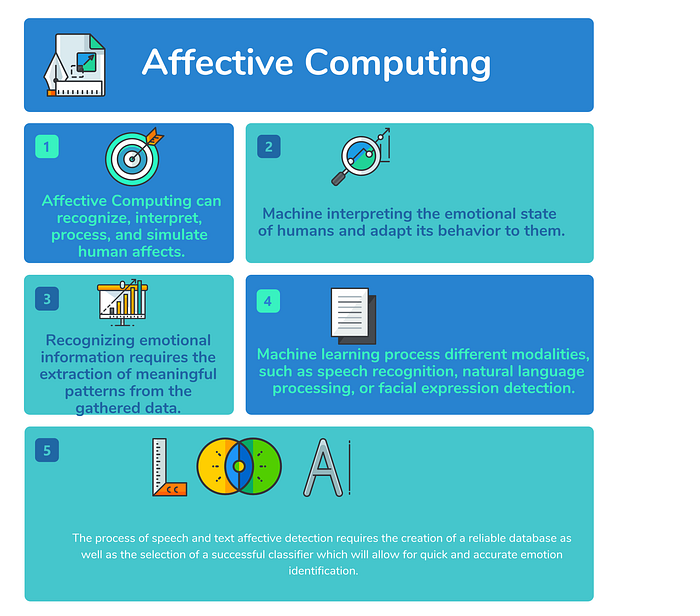 Image Credits: Predictiveanalyticstoday
Today, we are reaching the limits of our attention economy. Consequently, respecting people's attention, rather than gaining it, is becoming the new value.
We Have a Lot to Learn from Nature
Nothing in nature screams constantly. A tree's presence is silent, yet palpable. Even if the wind doesn't make its presence felt, its touch makes it felt. The physical world reveals its presence through harmony, not visibility. Therefore, you often feel its absence, not its presence.
This is the fundamental principle of Calm Tech: the system exists in the background, unobtrusive. A smart home system can adjust the light when you enter a room, but it should do so unnoticed — as naturally and effortlessly as the morning sun filtering through a slit in a curtain.
A truly "smart" system doesn't need to say "I'm there." This invisibility isn't a sign of weakness; it's a sign of maturity.
 AI-generated image
The Emotional Layer of Experience
UX literature has long been centered on "effectiveness" and "usability." However, research suggests that emotional resonance, not function, determines a product's memorability.
Stanford University's Web Credibility Project found that the overall visual design of a website plays a significant role when users evaluate its credibility. Research shows that users evaluate its credibility by paying attention to visual elements such as layout, typography, font size, and color scheme. In one study, 46.1% of participants based their credibility assessment on the attractiveness of a site's overall visual design. It was observed that they felt more confident in interfaces that were less distracting and easier to use. In other words, people don't lose control in quiet designs — on the contrary, they feel safe.
In other words, emotional experience (EX) is no longer an extension of UX; it's an evolution. When a user presses a button, they don't simply issue a command — they convey an intent. The system that understands that intention becomes not only "useful" but also "understandable".
 AI-generated image
A New Dialogue with Technology
For many years, technology has been defined by speed and power. Today, even the most advanced devices demand our attention with constant notifications, so we can no longer escape this technological noise. Calm Tech brings this relationship back to the human:
- Invisible yet reliable.
- Quiet yet responsive.
- Intelligent yet humble.
Just like a good friend: always there, yet not demanding attention.
 AI-generated image
The Design of Silence
The essence of Calm Tech is not "designing less," but "realizing better." Making a product quiet doesn't render it ineffective — it humanizes it.
In the architectural world, the Japanese aesthetic concept of "ma" holds that emptiness carries meaning. A similar philosophy applies in design: emptiness isn't absence; it's leaving space. Calm Tech gives that space back to the human.
Feeling Without Feeling
We argue that in the future, experience will evolve into a form that adapts to the user, rather than one that captivates them. Technology will recede from the spotlight and become a supporting presence behind the scenes.
A product will no longer be judged by how much attention it captures, but by how quietly it integrates into the user's life.
And perhaps then, technology will truly become an extension of the human being — an experience that evokes emotion without being felt.
Calm Tech isn't a trend; it's a way of reclaiming one's attention, time, and peace. The future of technology lies not in chaos, but in quiet harmony — like a quiet friend you can always count on.