
The Psychology of Latency
What happens in our brains when we stare at a spinning loading icon or wait for an AI model to generate a response?

What happens in our brains when we stare at a spinning loading icon or wait for an AI model to generate a response?
While our eyes perceive visual changes in a mere fraction of a second, every extra millisecond of waiting in a digital interface quietly steals from our working memory. When architecting scalable B2B SaaS platforms and digital products, one truth becomes highly apparent: speed is not merely a metric of how fast a server responds; it is a measure of how mentally exhausted the user becomes during that wait.
At this intersection, performance ceases to be just a software optimization task and evolves into a profound Human-Computer Interaction (HCI) challenge. Let’s step back from the codebase and dive into the science behind the 400-millisecond rule, the Doherty Threshold, and why modern AI tools are specifically engineered to exploit this very psychological loophole.
The 1982 IBM Study and the Theory of “Flow”
Until 1982, the universally accepted standard for system response time was a sluggish two seconds. The assumption was that waiting two seconds after entering a command was perfectly normal and did not hinder productivity.
However, IBM researchers Walter J. Doherty and Aravind J. Thadani shattered this long-held belief in their seminal paper. Their discovery was striking: when a computer and its user interact at a pace where neither has to wait on the other (<400ms), productivity does not just increase linearly—it scales exponentially.
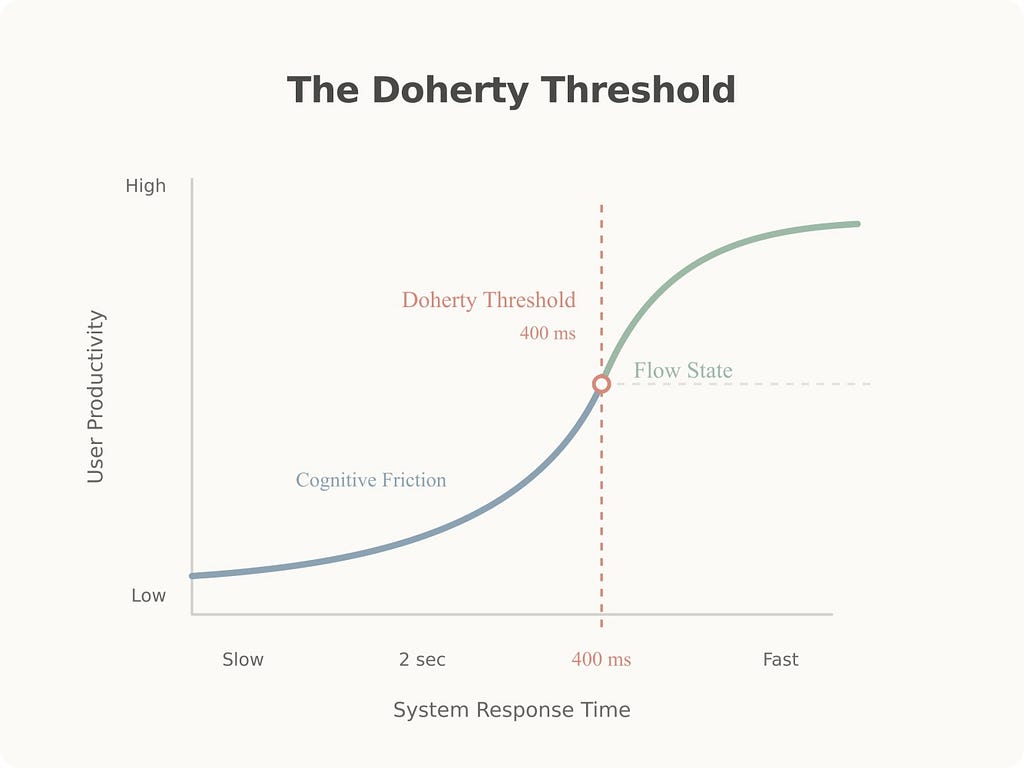 The Doherty Threshold
At this speed, users enter a psychological state known as “Flow,” a concept famously defined by Mihaly Csikszentmihalyi. The user loses awareness of the tool itself, maintaining an unbroken connection with their work.
The GenAI Paradigm: The Ultimate 400-Millisecond Test
If we look at the rapid adoption of modern Large Language Models (LLMs), their interface design is perhaps the most brilliant modern application of the Doherty Threshold.
Imagine if an AI waited until it formulated its entire, complex response before displaying it on your screen. The process could take seconds or even minutes. During that time, staring at an “AI is thinking…” spinner, the Doherty Threshold would be shattered, your attention would drift, and the system would feel incredibly clunky.
Instead, AI engineers focus intensely on a metric called TTFT (Time to First Token). The system doesn’t need to finish the whole paragraph; it only needs to drop the very first word onto your screen within 400 milliseconds. The moment our brains see that first keystroke, we register that the system has acknowledged our command and is actively working.
This token-by-token streaming architecture is not just a data transfer method; it is a psychological hack:
- Balancing Cognitive Load: Watching words appear sequentially mimics the natural rhythm of human reading, preventing the cognitive overwhelm of a massive text block appearing instantly.
- The Illusion of Labor: The interface typing out characters creates a tangible sense that the machine is “working hard” for you, making the total wait time highly tolerable.
- Sense of Control: If the response goes off track, the user can instantly hit “Stop generating,” preserving a sense of absolute mastery over the interface.
Cognitive Load and Calm Technology
Whether we are designing AI chat interfaces or complex B2B dashboards, the underlying principle is the same. Robert B. Miller’s foundational 1968 paper established that while a 0.1-second response feels instantaneous, a delay of 10 seconds causes the user to abandon their train of thought entirely.
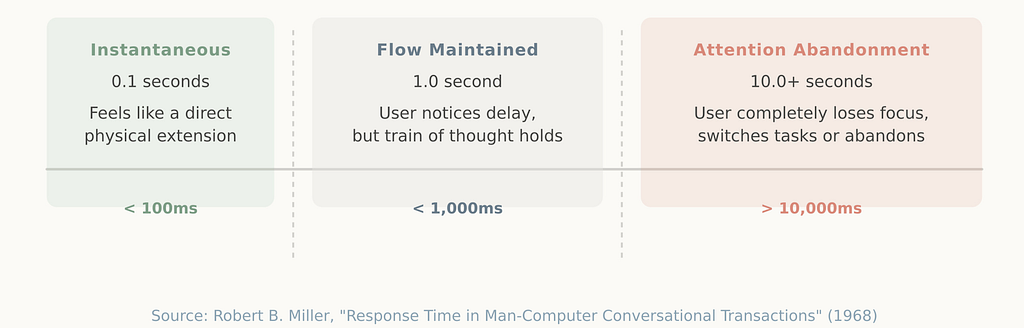
As response times stretch, our brains expend immense effort trying to keep our initial intent alive in our short-term memory. This friction generates high cognitive load.
This is exactly where the principles of Calm Technology become vital. A calm, noise-free interface does not aggressively demand user attention. By ensuring responses stay within the Doherty Threshold—either by genuine server speed or clever architectural illusions—the interface effectively becomes “invisible.”
The SaaS Solution: Optimistic UI Architecture
In the reality of modern software development, heavy database queries and complex cloud operations mean we cannot always achieve a true <400ms backend response. When the infrastructure cannot beat the clock, UI/UX architecture must bridge the gap.
For traditional transactional apps, the most effective strategy to maintain this state of flow is the Optimistic UI pattern. Instead of freezing the interface to wait for a 200 OK from the server, we invert the process. The moment a user interacts with a component (e.g., saving a setting or updating a record), the interface instantly updates to the success state.
// The Optimistic UI Approach:
// We update the interface instantly (<100ms) to satisfy the Doherty Threshold.
// The actual API request is resolved asynchronously in the background.

const handleSave = async (data) => {
  const previousData = getCurrentData(); // Remember state, in case we need to roll back

  // 1. Instantly switch UI to success state (Flow remains unbroken)
  updateUI(data);

  try {
    // 2. Write to server in the background (Actual wait time > 800ms)
    await api.saveData(data);
  } catch (error) {
    // 3. Gracefully revert UI only if an error occurs, with minimal friction
    revertUI(previousData);
    showToast("Unable to save. Please try again.");
  }
};
Through this architectural approach, even if the actual server response takes over a second, the perceived latency is reduced to milliseconds. The user gets their dopamine hit of task completion instantly and moves on to the next action without cognitive friction.
Technology feels like magic when it seamlessly matches the speed and rhythm of human thought. The 400-millisecond threshold is not just a performance target; it is the psychological boundary of the human-machine relationship.
We spend countless hours perfecting typography, layout, and whitespace to eliminate visual noise. Yet, the most exhausting noise in any digital product is completely silent: it is the friction of waiting. True architectural elegance is not about showing the user how powerful your backend is; it is about hiding the system entirely. When technology finally responds within those critical 400 milliseconds, it ceases to be software. It becomes an invisible, seamless extension of the human mind.
Further Reading and References
To build scalable, user-centric products, exploring the intersection of psychology and system architecture is essential. Here are the foundational texts that shaped this framework:
- Laws of UX: Doherty Threshold (Jon Yablonski): A brilliant breakdown of the 400-millisecond rule and its core principles in modern design.
- The Economic Value of Rapid Response Time (1982) — Walter J. Doherty & Aravind J. Thadani: The original IBM research that proved the exponential productivity gains of sub-400ms interactions.
- Response Time in Man-Computer Conversational Transactions (1968) — Robert B. Miller: The definitive academic work on the limits of human attention and cognitive load.
- Flow: The Psychology of Optimal Experience — Mihaly Csikszentmihalyi: The foundational text on the psychology of entering the highly focused “Flow” state.
- Calm Technology — Amber Case: A guiding philosophy on designing technology that works quietly in the background without causing cognitive fatigue.