
The Betty Crocker Paradox: Why Using AI Feels Like Cheating (And How to Fix It)
For years, UX obsessed over removing all friction. But in the AI era, adding “meaningful friction” is the secret to building products users
 AI generated image
It's the silent crisis of every modern professional.
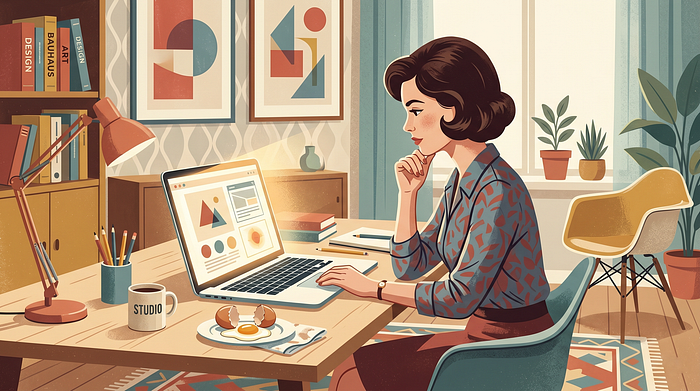
You sit down to write an important proposal, design a complex UI, or draft a strategy document. You open ChatGPT, Claude, or Midjourney. You type a prompt, press enter, and in five seconds, the screen fills with a near-perfect result.
You should feel ecstatic. You just saved three hours of grueling work. Instead, a quiet, uncomfortable feeling creeps in: Guilt. You feel like a fraud. You feel like you didn't earn the output. It feels like cheating.
Yet, the alternative is equally painful. If you stubbornly refuse to use AI and spend hours grinding away at the same task, you feel like a dinosaur, willfully ignoring the most powerful tool of our generation.
Use AI, feel imposter syndrome. Don't use AI, feel obsolete.
This is the psychological trap of our era. But to understand how to escape it, we need to look back at a seemingly unrelated crisis from the 1950s: The mystery of the instant cake mix.
The Betty Crocker Paradox
In the mid-20th century, food giants like Betty Crocker and General Mills introduced a revolutionary product: the instant cake mix. It was the ultimate "zero friction" solution. All a housewife had to do was add water, stir, and put it in the oven.
It was a miracle of food engineering. And it was a spectacular failure in the market. Sales plummeted.
Baffled, the companies hired legendary consumer psychologist Ernest Dichter to figure out why women were rejecting such a convenient product. Dichter's research revealed a fascinating human truth: The process was too easy.
Because the cake required absolutely no effort, the women baking them felt a subconscious sense of guilt. They felt they were deceiving their families by presenting a cake they hadn't truly "made." The lack of friction robbed them of the psychological reward of baking.
Dichter's solution was brilliantly counterintuitive. He told the companies to make the process harder.
They removed the dried egg powder from the mix. They changed the instructions: "You add the eggs — You know they're fresh!" By requiring the user to crack their own egg, the companies reintroduced a vital element: Meaningful Friction. The user contributed something raw and personal to the process. They earned the cake. Sales skyrocketed.
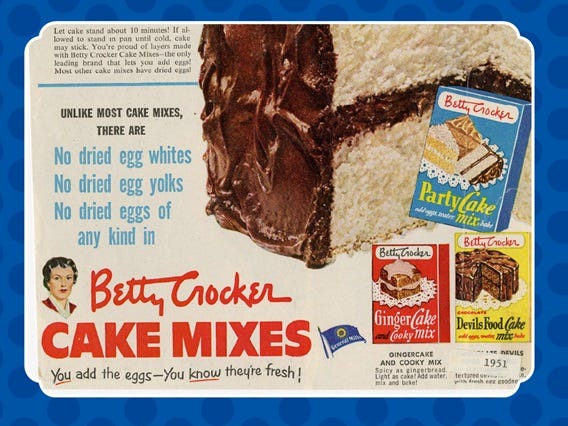 Image Credit: General Mills
The AI Era is Just a Giant Cake Mix
Today's generative AI tools are the ultimate 1950s cake mix. They are perfectly engineered to require nothing but "water" (a prompt).
For the past decade, the tech industry has been obsessed with "Zero Friction." The holy grail of Product Management and UX Design was to remove every possible barrier between the user and the end goal. One-click checkouts, auto-fills, instant generation.
But as behavioral economists know through the "IKEA Effect," we only value things we put effort into. The lopsided table you spent two hours assembling means more to you than the perfect one delivered pre-built.
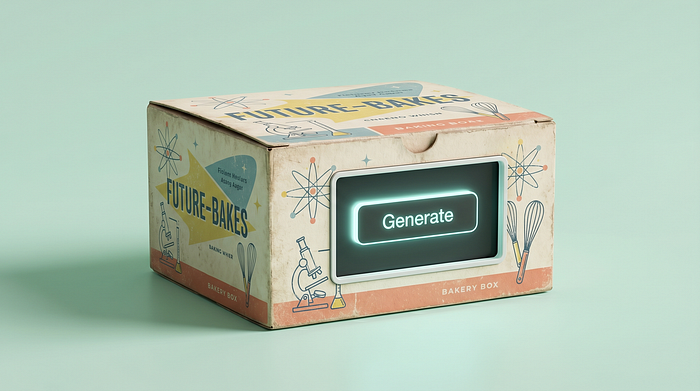
When an AI generates a perfect wireframe or a flawless blog post with zero friction, we experience the Betty Crocker Paradox. We didn't crack the egg. We didn't bleed over the keyboard. Therefore, we struggle to take pride in the result.
 AI generated image
How to Fix It: Cracking the Digital Egg
How do we break out of this guilt-vs-obsolescence trap? How do we build — and use — AI products that don't strip away our sense of ownership?
The answer lies in designing and embracing Meaningful Friction.
 AI generated image
For Product Builders & Designers:
Stop trying to build "magic button" solutions that do 100% of the work. If your AI tool generates a final output with no human intervention, you are building a product that users won't emotionally connect with.
Instead, position AI as a co-pilot, not an autopilot. Let the AI do the heavy lifting (mixing the flour and sugar), but force the user to make the final, creative decisions. Instead of building a one-click 'Generate & Publish' button, design an 'Iterate' interface. Present the AI's output not as a final product, but as raw clay. Require the user to mold it, tweak the tone, or make the final call. Let the AI do the heavy lifting, but give your users an egg to crack.
For AI Users & Creators:
You need to change your relationship with the output. If you are using AI as an oracle — asking it for the final answer and copy-pasting it — you will always feel like a fraud. Instead, use AI as a sous-chef.
- The First 10%: You provide the raw, messy, human idea (The vision).
- The Middle 80%: The AI handles the boilerplate, the formatting, and the heavy lifting (The flour and water).
- The Final 10%: You inject the nuance, the taste, the "vibe," and the final polish (Cracking the egg).
The Future Belongs to the Egg Crackers
We are not going back to a pre-AI world. The cake mix is here to stay.
But the most successful professionals of the next decade won't be the ones who blindly accept the AI's first draft. They will be the ones who learn how to orchestrate the AI, infusing its immense computational power with their own distinct human taste, empathy, and effort.
Don't let the machine bake the whole cake. Get your hands a little dirty. Crack the egg.