
Prompt and Pray: Are you Gambling with Generative AI?
The Failure of Strategic Thinking and the Paradox of Uncertainity in AI Interaction
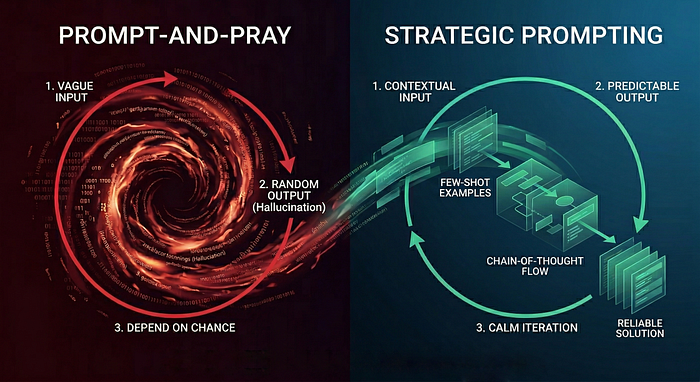 Prompt-and-pray vs strategic prompting
We were all there. Sitting in front of the screen, condensing that brilliant idea in our heads into a single sentence, pressing "Enter," and… waiting. Our hearts raced a little, and we silently prayed, "Please, this time, let it be exactly as I want it." That moment is called "Prompt-and-Pray" in digital literature.
In this era where we've placed artificial intelligence at the center of our lives, we're unknowingly becoming "digital gamblers." So why don't we rely on strategy instead of luck?
Why do we pray?
Truthfully, the fault isn't ours, it's human nature. When we talk to artificial intelligence, we feel as if we're dealing with a mind that understands us completely and empathizes with us. In the Human-Computer Interaction (HCI) literature, this is called anthropomorphism (attributing human characteristics to inanimate objects).
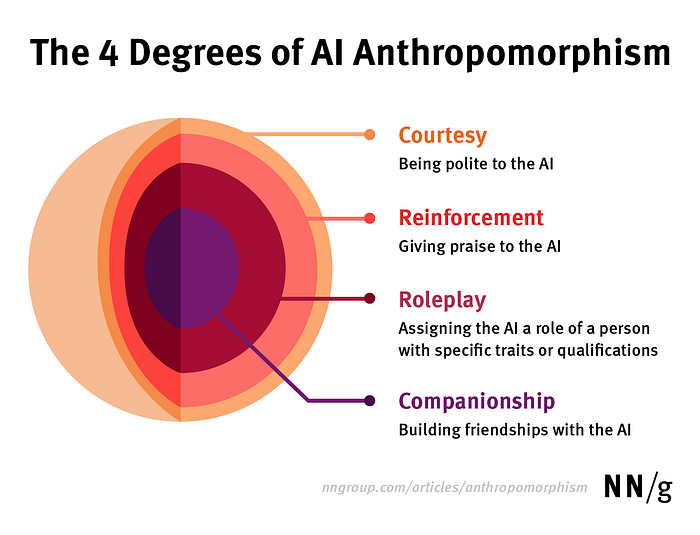 Image Credit: NN Group
As Ethan Mollick and Marcel Binz (2023) also emphasize in their work, viewing artificial intelligence as a mind-reading "oracle" actually causes us to miss its statistical reality. Large Language Models (LLMs) don't sense your intention; they only calculate word probabilities.
Besides this, there's the Cognitive Offloading factor. As Ziwei Ji and his research team (2023) have shown, the incomplete commands we give out of fatigue, thinking "I won't bother, let the AI think for me," dramatically increase the probability of the model experiencing "hallucinations" (producing false but believable information) to fill in the gaps.
The Jagged Frontier
Why do some of our prompts work perfectly, while other times the system completely fails? The answer lies in a massive experiment conducted by Boston Consulting Group (BCG) with 758 highly qualified consultants, published in the journal Organization Science in 2026.
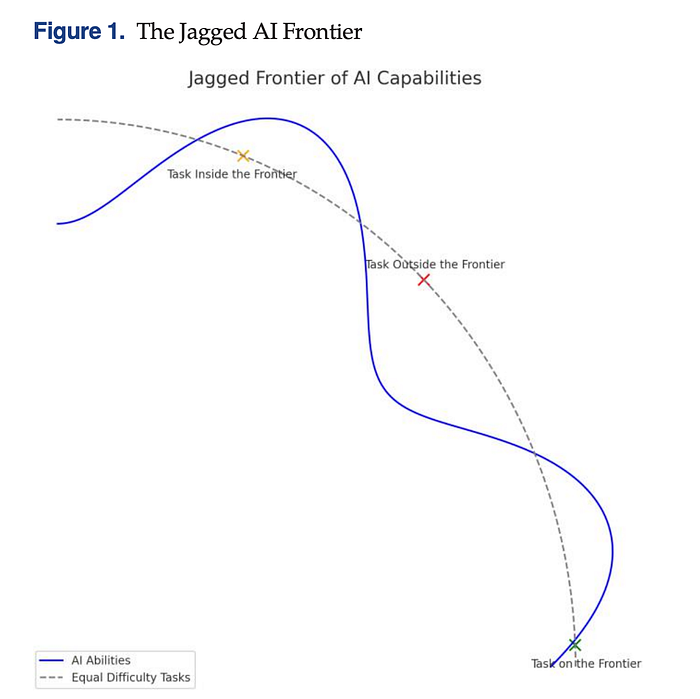 Image Credit: Dell'Acqua et al (2026) The figure offers a conceptual depiction of the jagged technological frontier of artificial intelligence. The dashed line represents tasks of difficulty that are perceived as roughly equal by human knowledge workers. Tasks that appear similar in difficulty to humans may fall on opposite sides of the boundary; this could lead to AI assistance increasing performance for some tasks while decreasing it for others.
Fabrizio Dell'Acqua, Ethan Mollick, Katherine Kellogg, and their colleagues coined a concept they call the "Jagged Technology Frontier" to describe these variable capabilities of artificial intelligence. According to this academic observation, AI:
Is a massive enhancer in tasks that stay within the boundary. Professionals participating in the experiment who used AI completed 12.2% more tasks, finished their work 25.1% faster, and significantly improved their work quality compared to those who did not use AI.
However, things change when you go beyond the boundary. In a seemingly equally difficult but complex task requiring human reasoning, the probability of participants using AI finding the correct solution dropped by 19%.
Falling Asleep at the Wheel
The real danger here is that users cannot predict where this boundary begins and ends. This is where the problem of overconfidence, described by Dell'Acqua (2022) as "falling asleep at the wheel," comes into play. Even if the AI makes a flawed analysis in tasks outside the boundaries, it presents its arguments so consistently and convincingly that professionals blindly believe it and lose control.
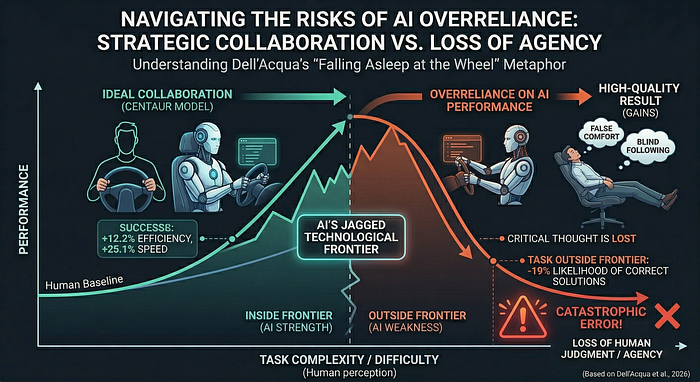 Based on Dell'Acqua et al 2026
From Gambling to Cooperation
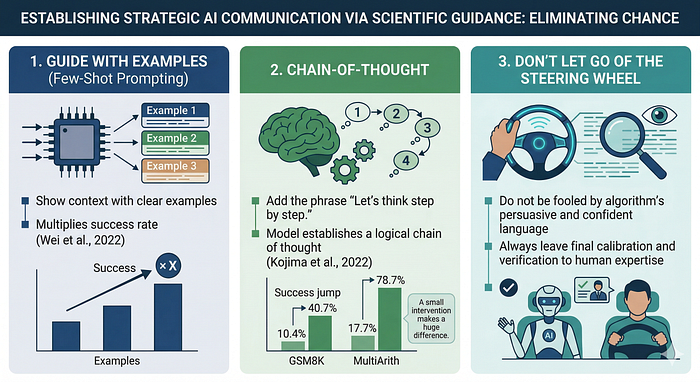
Eliminating the "prayer" phase from our lives and establishing strategic communication is actually easier than we think. To eliminate chance, we should again turn to the guidance of scientific research:
- Guide with Examples (Few-Shot Prompting): As Jason Wei and his team (2022) showed, instead of simply telling the AI what to do, showing the context with clear examples multiplies the success rate.
- Chain-of-Thought: Takeshi Kojima and his colleagues' (2022) famous study proves that simply adding the phrase "Let's think step by step" to the end of the command enables the model to establish a logical chain of thought. In fact, in a complex math test (MultiArith) used in the study, the success rate jumped from 17.7% with the standard command to a remarkable 78.7% with this single phrase. In another challenging dataset (GSM8K), the success rate increased from 10.4% to 40.7%. Such a small intervention makes such a huge difference.
- Don't Let Go of the Steering Wheel: Don't be fooled by the algorithm's persuasive and confident language; final calibration and verification should always be left to your human expertise.
 Strategic thinking
Transforming the immense potential offered by artificial intelligence from a source of chaos, stress, and uncertainty into a reliable design partner is truly a matter of vision. We've always used a guiding principle in our own product development processes: "Calm Tech for Complex Needs."
The "prompt-and-pray" approach is the complete opposite of this calmness; it increases mental strain, eliminates the sense of control, and turns the process into a game of chance. The true purpose of technology isn't to exhaust or keep us on edge, but to simplify complexity and return the mental space we need to focus. When we tell AI to "think step by step," providing a clear framework, or when we understand those "rough boundaries" and know when to take the wheel, we are actually transforming this immense power into that "calm" form.
AI isn't a magic sphere that works miracles; it's our most powerful tool for realizing our vision when we overcome anthropomorphic biases and understand its limitations. Let's not leave this new interaction we're having with digital tools to chance; let's overcome complexity with strategy and uncertainty with calm design.