
PoC in AI Project: What to Prove and What Not to Prove?
A practical guide to validating AI ideas, avoiding common PoC pitfalls, and building a realistic path from concept to production.
 PoC:Proof of Concept
AI's promise to transform the business world is truly captivating — reducing costs, generating new insights, improving the customer experience… The list goes on.
But many AI projects that begin with excitement unfortunately stall right at the beginning. One of the most critical steps in this journey is Proof of Concept (PoC).
Proof of Concept (PoC) actually asks a simple question:
"Is this idea actually possible to work?"
Unfortunately, many teams misunderstand Proof of Concept (PoC) — they either focus solely on getting the model working or, conversely, turn the Proof of Concept into a mini-product development project.
Let's look at the things you really need to prove in an AI Proof of Concept (PoC) and the things that will only waste your time.
AI is now being discussed in every industry, but a large portion of projects fail to transition from the PoC or pilot phase to real-world implementation. According to IBM research, 35% of companies are using AI, but a significant portion are still at the beginning of the process and face significant challenges transitioning from PoC to production.
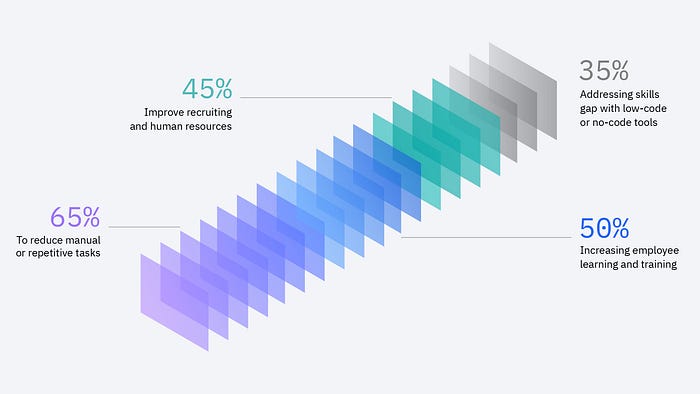 Image Credit: How organizations are using AI to address labor or skill shortages
More often than not, the problem isn't a technical glitch. It is about:
- unclear business objectives,
- unnoticed data quality issues,
- inaccurate estimation of integration issues or,
- teams placing incorrect expectations on the PoC.
In short, the PoC in AI projects is critical for both mitigating risk and establishing a realistic roadmap. But this requires ensuring that the PoC answers the right questions.
That's why PoC is the decisive stage in determining the fate of an AI project — when done right, it accelerates success; when done wrong, it wastes months.
1. Prove Business Value, Not Just Technical Success
The most common mistake in AI is:
"The model works, so we're successful."
However, just because a model works technically doesn't mean it works from a business perspective.
The important thing is that it answers these two questions:
- Does this solution actually create value?
- And can we measure it?
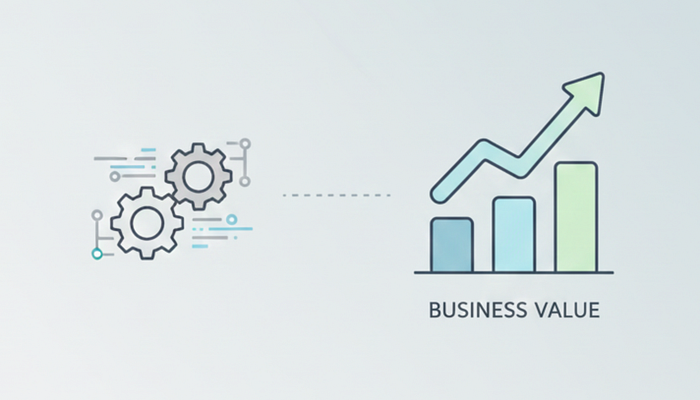 Business value is as important as technical values
For example: A fraud detection PoC isn't considered successful simply because of its "high accuracy rate."
The real success lies in:
- how many dollars in losses can be prevented,
- how many false alarms can be reduced,
- how operational burdens can be reduced.
In other words, the issue isn't the algorithm, but the impact.
2. Test Data Availability: Quantity, Quality, Access
Data is the fuel of AI, and let's be honest: most companies' data is more problematic than they realize.
Many AI projects fail because:
- data is incomplete,
- data is scattered,
- data access takes weeks or
- data cleaning is 10 times harder than you think.
One of the most important tasks of a PoC is to demonstrate the data's authenticity.
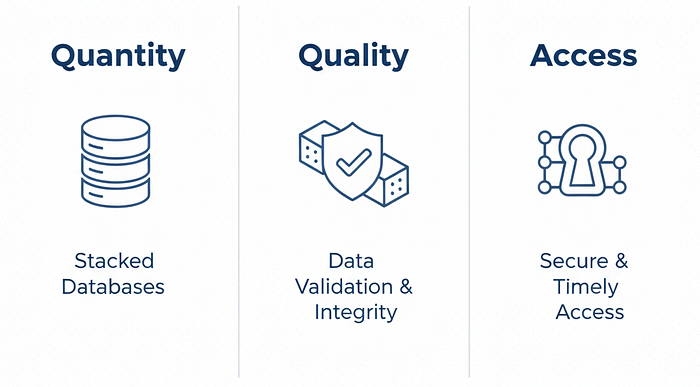 Test Data Availability
For example: Many companies say during a PoC,
"Our data is fine; we've been measuring it for years."
Then, when they start pulling in real-world data, it becomes clear: labels are inconsistent, silos are not integrated, access is restricted due to privacy regulations, and data cleaning requires significant engineering.
A good PoC uncovers these issues early, so teams can develop a realistic path forward.
3. A PoC Isn't a Product. Your Goal is to Learn Fast.
The goal of a PoC is:
"Learn the most for the least cost."
But many teams overburden a PoC with unnecessary work:
- microservices architecture,
- full security layer,
- flawless UI,
- massive integrations…
These aren't the work of a PoC. They're for pilot or production.
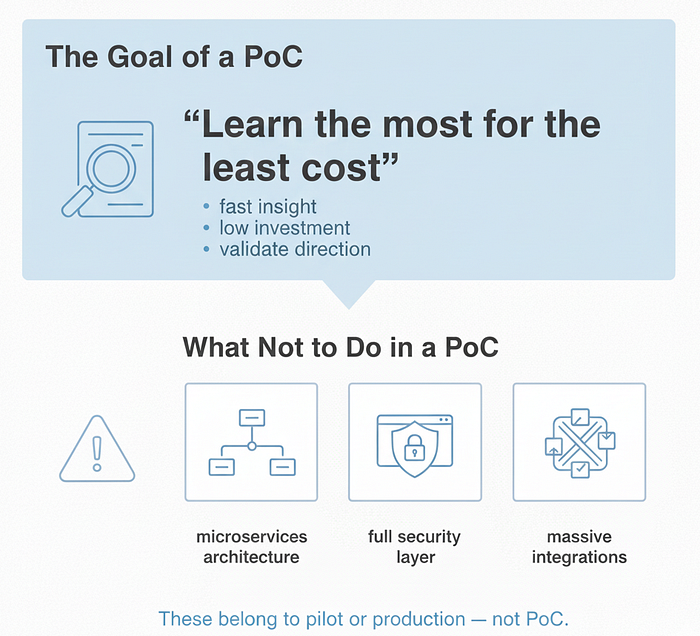 The goal of PoC
For Example: If you're building a recommendation engine PoC: ✅ Prove recommendation quality on a small user segment ✅ Don't worry about integration across the entire platform, user interface, scalable infrastructure, etc.
The success of a PoC is based on what you learn — not perfection.
Siemens Healthineers conducted several PoCs to test failure prediction models for medical devices. The goal of the PoCs was:
Can we really predict failures?
The priority wasn't to build a technically flashy system, but to prove its business value:
- fewer failures,
- less downtime, faster service.
This clarity allowed them to grow the project in the right direction.
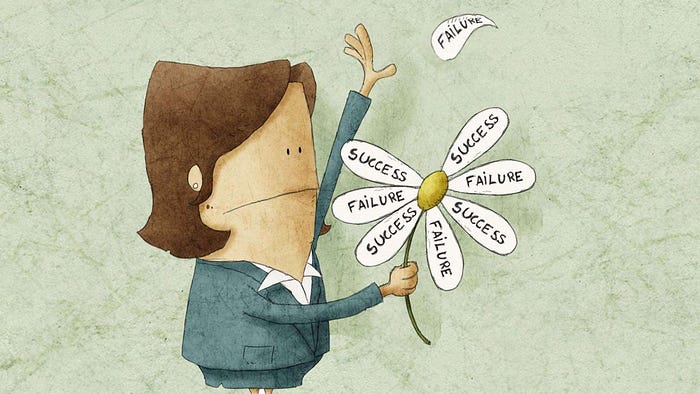 Image Credit: The Context of Things
Ryan Somers' Oracle Retail article clearly demonstrates that modern demand forecasting processes can no longer rely solely on historical sales data; they require continuous analysis of customer behavior, sales trends, channel preferences, and other external factors.
As Somers emphasizes, real-time data flow, integration of the forecast with systems like inventory, sales, returns, and order management, and minimizing manual intervention are critical for AI-based demand forecasting to generate value.
The examples given in the article show how eliminating manual intervention and significantly increasing forecast accuracy in Oracle Retail Demand Forecasting demonstrate the crucial importance of this integration. Therefore, the types of problems many retailers experience with AI PoCs — manual data loading, lack of real-time flow, or inability to integrate the model with legacy systems like ERP — sound directly align with the operational realities Somers points out.
The message underlined in this article is clear: an AI PoC must prove not only model accuracy but also the sustainability of the data flow and the feasibility of operational integration in real-world applications.
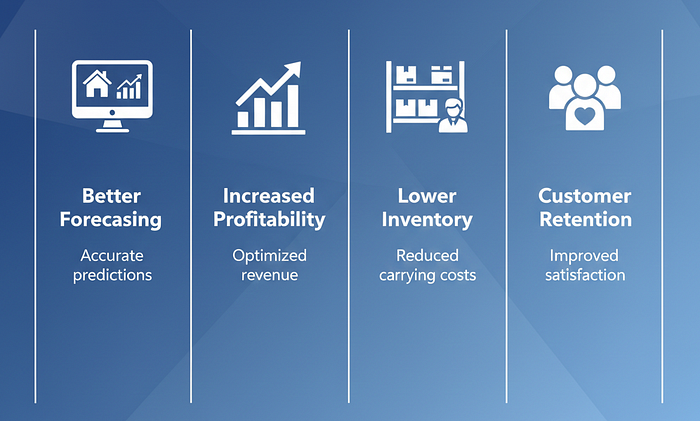 Demand Planning
PoC vs MvP: What's the Difference?
A PoC answers the question: "Is this technically feasible?"
An MVP answers the question: "Does this create real value for users?"
In short,
- A PoC mitigates technical and data risks.
- An MVP validates product-market fit and actual usage.
They solve different problems; mixing them leads to delays, wasted effort, and false expectations.
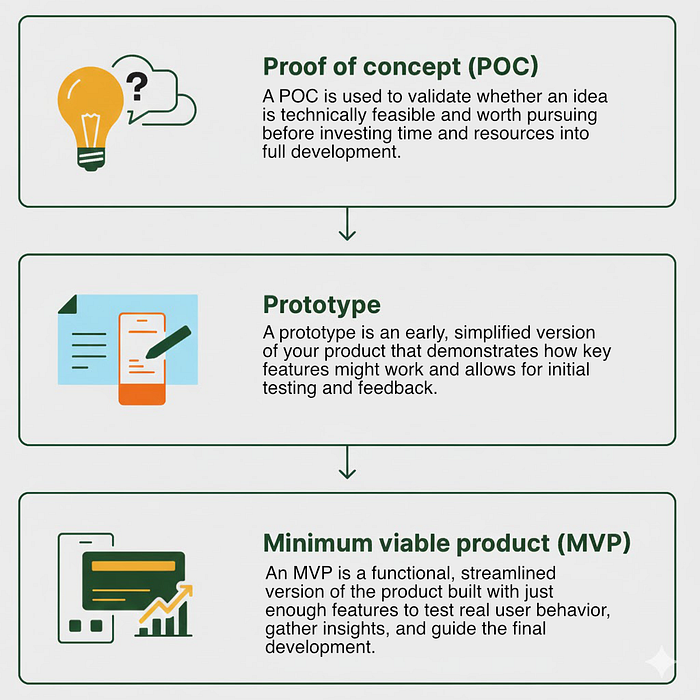 PoC vs MVP
What Should You Prove?
✅ Business Value: It should be clear how success will be measured and what this means for the business.
✅ Data Preparation: Is the data actually usable? Is it incomplete? Is it accessible?
✅ Basic Technical Suitability: Can the model solve this problem in principle?
✅ Risks and Assumptions: Testing the most critical risks early on can yield significant savings.
What Should You Not Prove?
❌ Production Architecture Isn't the PoC's job.
❌ "Perfect" Results Perfection doesn't exist in real data. What matters is potential.
❌ Do Everything at Once A PoC should be small. A "prove everything" approach only slows things down.
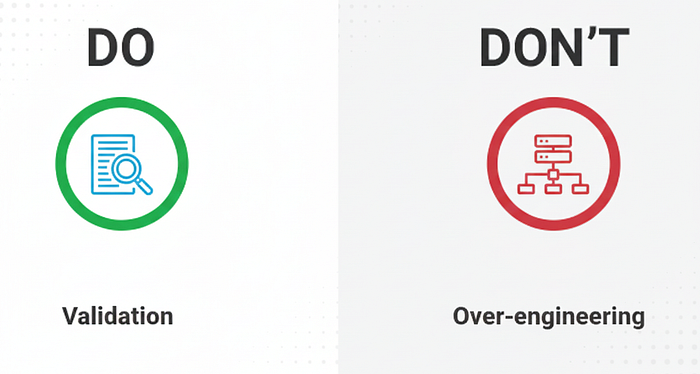 Do vs Don't
A PoC done right accelerates AI projects, reduces risks, and puts teams on a realistic roadmap. A PoC done wrong only wastes time.
The key is to remember that a PoC is a learning tool, not a "mini-product."
Want to be the first to see new posts? Subscribe to get updates straight to your inbox.