
Nobody Really Looks at Those Huge Dashboards
Do you remember the moment you set up or used your first automation in the company? We were happy, saying, “Everything is automatic now!”…
 AI generated image
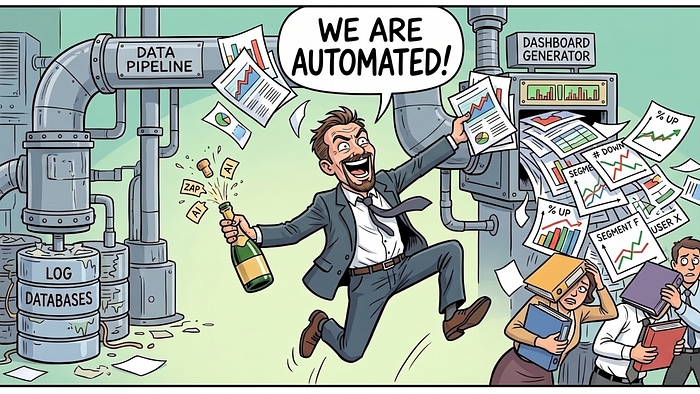
Do you remember the moment you set up or used your first automation in the company? We were happy, saying, "Everything is automatic now!" Systems connected to each other, and hundreds of rows of logs started flowing into databases every second. Then, we took it a step further. We built a huge, colorful "Dashboard" with 15 tabs just to see all this data.
In the first week, everyone looked at that screen like they were hypnotized. In the second week, only the managers looked. After the third week… no one.
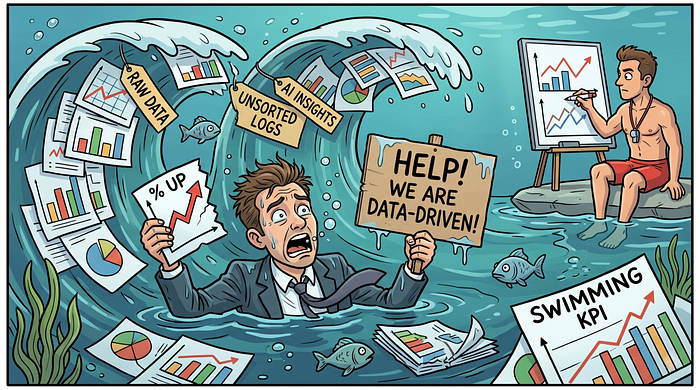
Because behind closed doors, there is a truth we all know but rarely say out loud: In the B2B world, we have already crossed the thin line between being "Data-Driven" and drowning in data.
 AI generated image
Dark Data: The Garbage We Pay for Every Month
We think collecting data is the same thing as understanding the business. The AI tools we connect to the system can generate reports with thousands of rows every morning. We feel safe by saying, "We have a lot of data." But that is not really the case.
Recently, we looked at a previously published article on Forbes. According to Forrester's market analysis, 73% of the data companies collect with great excitement is never used for analytics. Gartner gave a very accurate name to this huge pile of data that businesses spend money to collect but never look at: "Dark Data".
So, with those cool automations and data pipelines, we are not actually feeding our decision-making processes. We are just building dark, digital data warehouses that no one enters, and we pay server bills for them every month.
That Famous Monday Meeting and the Blame Game
We all know the clearest example of this data fatigue in the office. Think of a classic Monday morning growth meeting.
A huge Mixpanel or PowerBI dashboard is open on the screen. Red and green arrows and pie charts are all mixed up. Traffic increased by 5%, but the conversion at the payment step dropped by 2%. The CEO asks from the end of the table: "Why?"
First, there is a deep silence in the room. Because that showy panel only tells you what happened, not why it happened or how to solve it. Right after that, the famous blame session begins: The marketing team says, "Last week's product update broke it." The product manager throws the problem back, saying, "The traffic from your ads is low quality." From the back, the software team tries to escape by saying, "If the code was actually broken, QA wouldn't have approved the release."
While everyone looks at that huge data and blames each other, finally that saving sentence is spoken: "Let's examine this in detail during the week and talk about it at the next meeting." That dashboard is closed, and work continues exactly as before.
 AI generated image
Putting the Heavy Burden of Analysis on the User
This is the biggest problem of today's software. We put a huge pile of hay in front of the user and say, "The needle is somewhere around here, we gave you full control, now find it." This is not good interface design; this is putting the heavy burden of analysis on the user's shoulders.
If you give a person too much raw data and too many graphs, they experience the famous "Analysis Paralysis" mentioned in Cognitive Load Theory, and they cannot make any decisions.
The Solution: Calming Down
This is why we care so much about the "Calm Tech" vision. We do not need more graphs or more log flows anymore. What we need is to simplify.
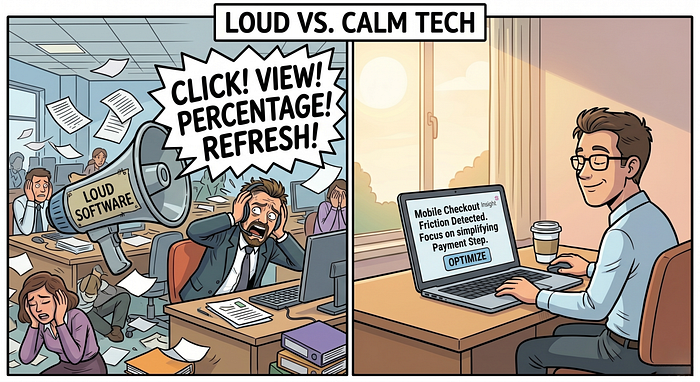
Good software does not throw 40 metrics on your desk and say, "You find the problem." Good software processes that huge amount of data silently in the background, without making you tired. It ends that "blame game" in the meeting before it even starts. On Monday morning, it comes to you with this one-line, intent-driven notification:
 AI generated image
"The 2% drop on the payment page is caused by mobile users leaving quickly from the new ad campaign launched yesterday. Click here to open a campaign optimization task for the marketing team."
Loud software just throws data at you. Calm software gives meaning to data and makes you take the right action.
👇 So, what is the situation in your company? How much of those cool automations and reports really turn into an action, and how much just gathers dust in the corner as "dark data"? Let's meet in the comments.
Originally published at https://www.linkedin.com.