
Is Your B2B Software the Loudest Employee in the Room?
Unpacking the psychology of feature bloat and the hidden cost of demanding interfaces.
 AI generated image
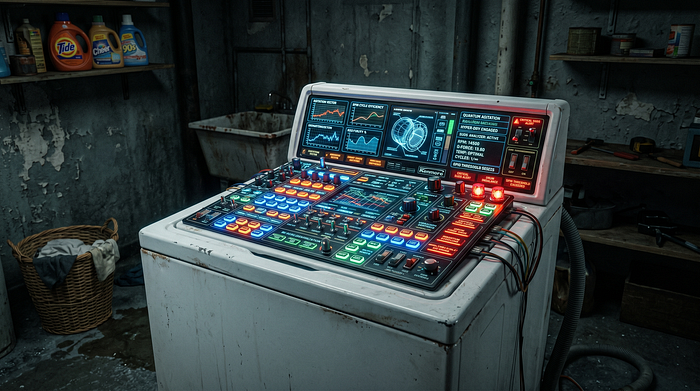
It's midnight. You've just spilled coffee on your favorite shirt. You stand in front of your washing machine, and you're met with a control panel that looks like a spacecraft dashboard.
Synthetics 40°C. Pre-wash. Eco-Cotton. 800 Spin. Rinse Hold.
Why do manufacturers build machines this way? It rarely has to do with actual user needs. It's about showroom psychology. When a customer walks into a store, the brand wants to point to a massive, complicated panel and say, "Look at all the things this can do. Look at the value you are paying for."
It is a marketing gimmick disguised as product development. And unfortunately, the B2B SaaS industry has adopted the exact same playbook.
The "Loud Employee" Syndrome
 AI generated image
Think about your workplace for a second. We all know that one person. The employee who spends 20% of their time actually working, and 80% of their time making sure management knows they are working. They send unnecessary update emails. They speak the loudest in meetings. And when promotion season rolls around? They usually get the nod.
Meanwhile, the senior engineer who silently refactored the entire database architecture gets overlooked. Why? Because invisible competence is hard to sell.
We build B2B software with the exact same toxic psychology. We design products that act like the loud employee.
Software companies are terrified that if the product just works silently in the background, the client will cancel their subscription. So, the software is engineered to shout. It fires off daily summary emails. It flashes red notification badges. It forces the user to navigate through 15 dropdown menus just to complete a basic task. The interface is desperately crying out: "Look at me! Look at how complex I am! Validate my monthly invoice!"
The Fast-Food Era of Software
 AI generated image
This desperation to prove value has pushed us into the fast-food era of software development.
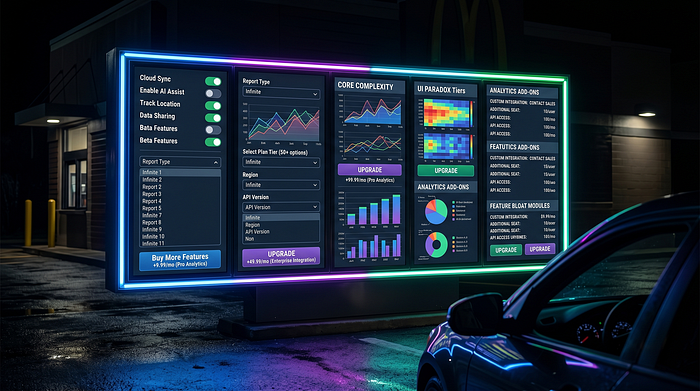
The goal is no longer to craft high-quality, sustainable solutions. The goal is to churn out as many features as possible to justify higher pricing tiers. Think about a fast-food meal. It's cheap, it's served immediately, and the menu is overwhelmingly large. You eat it, you feel temporarily full. But a few hours later, you just feel heavy and hungry again. It never replaces the satisfaction of a calm, carefully prepared meal at a quality restaurant.
When we expose our entire database schema on the screen, we are serving our users fast food. We call it "empowering the user." In reality, we are just forcing them to become system administrators.
When a B2B platform requires a certified specialist just to operate its basic functions, the design has failed. The user gets exhausted. And exhausted users eventually churn.
The Rise of Intent-Driven SaaS
If feature bloat is the fast-food drive-thru, Intent-Driven Design is a Michelin-star restaurant. But to really understand how this architecture behaves, we need to look outside of the kitchen and look at Gotham City.
 AI generated image
When you think about the ultimate silent expert, think about Batman. He doesn't stick around after saving Gotham to ask for a 5-star rating. He doesn't hand Commissioner Gordon an itemized invoice of the complex gadgets he used. He identifies the intent (stop the bad guys), executes the complex logic (the fight), and vanishes into the night.
Software should work exactly the same way. The user states their goal. The system handles the complexities of execution. The interface remains silent, stepping in only to confirm success or ask for critical human judgment.
Engineering the "Silent" Workflow
You cannot have a calm interface if your front-end is managing the weight of the system's logic.
Rather than tightly coupling the UI to the database, we build an intelligent middleware layer. Think of it as the invisible backend staff that catches, processes, and routes data asynchronously.
Here is the difference in how solutions should be architected:
 AI generated image
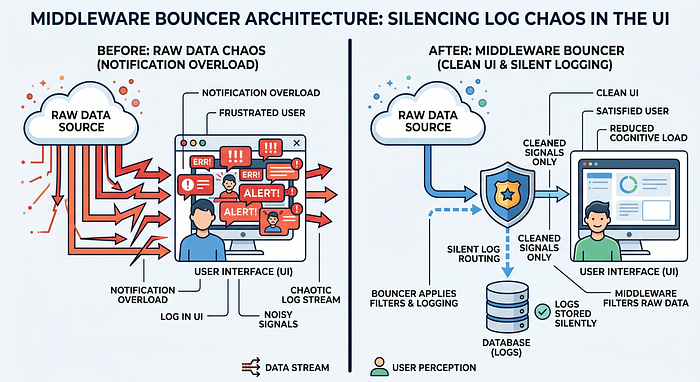
The Fast-Food Approach: The system encounters background events (data syncs, minor errors, API limits). The UI is tightly bound to these events. It immediately fires off five different toast notifications. A red badge appears on the dashboard. The user is forced to manually clear logs. The interface demands attention for variables the user doesn't even need to control.
The Intent-Driven Approach: The system acts as a buffer. Event-driven workers handle the noise silently in the background, log the data directly to the database, and leave the interface completely undisturbed.
To achieve this, we engineer a concept we call the "Rule of Silence" into the core architecture. Instead of building UI components that react to every server ping, we build background workers that act like digital bouncers.
When a barrage of data hits the system, the middleware filters the noise. It logs the routine updates directly to the database without ever alerting the front-end. The system is explicitly designed to do absolutely nothing — to remain completely silent — unless a critical issue blocks the user's workflow and requires human judgment.
By pushing this cognitive burden to an asynchronous background layer, the front-end remains lightweight and distraction-free. The software becomes a silent partner. Not a loud, demanding employee.
It's Time to Start Selling Focus.
If you are building a SaaS product in 2026, your competitive advantage is no longer the sheer volume of integrations you have. It isn't the density of your dashboards.
Your true advantage is Cognitive Relief.
It's time to stop building software for the showroom. Hide the complex engineering in the backend. Utilize smart defaults for 90% of your users, and bury the advanced configurations deep in the settings for the 10% who actually need them.
Let the code handle the heavy lifting. Let the users get back to their actual jobs.