
Architecture as a Product: Why Your Tech Stack is Your Biggest UX Constraint
Stop treating your backend as a black box and start seeing it as the foundation of your user’s emotional journey.
 AI-generated image
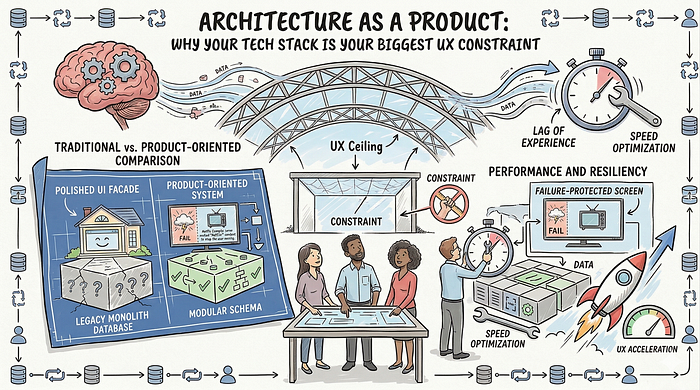
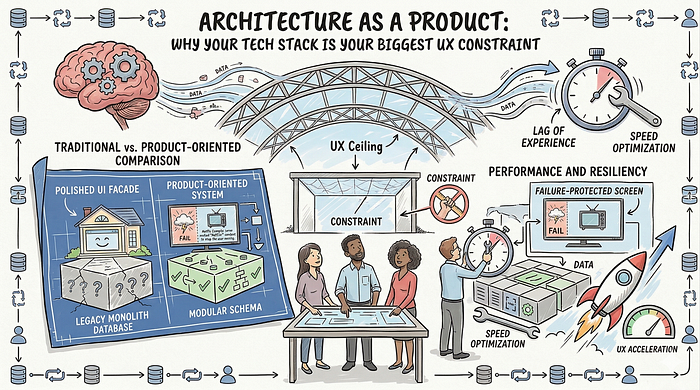
We've seen how world-class user interface designs can collapse under the weight of a 5-second API response. It's a harsh reality: high-quality prototypes are meaningless if the infrastructure is struggling to breathe.
User experience (UX) is often simplified to simply a collection of pixels, colors, and micro-interactions. But this visual layer is only the surface. In high-risk enterprise SaaS applications, even the most polished interface remains a 'facade' if the underlying architecture doesn't support the user's intent.
If your technical foundation is rigid, your user experience will eventually become fragile. It's time we stopped treating architecture as a hidden cost and started treating it as a core product feature.
 AI-generated image
Case Study: Netflix and Graceful Degradation
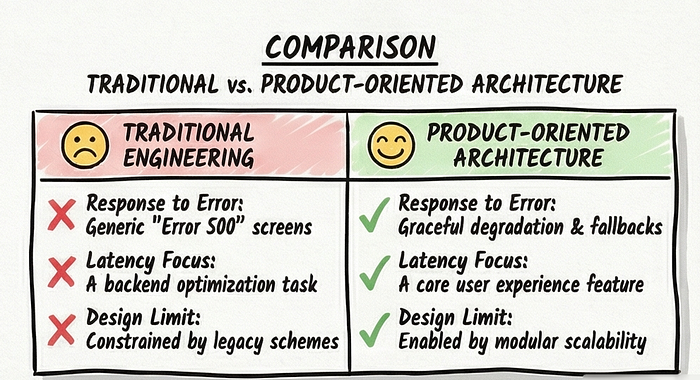
To understand this shift, look at how industry giants protect the user journey. In a monolithic architecture, a single failing component can take down the entire user experience, serving the dreaded "Error 500" page.
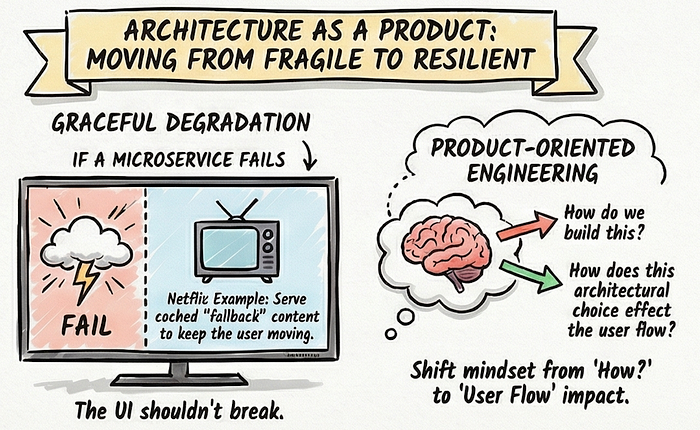
Netflix solved this by pioneering "Chaos Engineering" and architecting for failure. What started with their legendary Hystrix library has now evolved into an industry standard powered by modern tools like Resilience4j and service meshes like Istio. Thanks to this circuit-breaking mentality, if a personalized recommendation microservice goes down under heavy load, the UI doesn't break.
 Image Credit: https://github.com/netflix/hystrix
Instead, the architecture gracefully degrades, serving a cached, fallback list of globally trending shows. The user continues to browse and stream, completely unaware of the backend chaos. Here, the architecture acts as an invisible shield, protecting the user's emotional state from technical realities.
The "Lag" of Experience
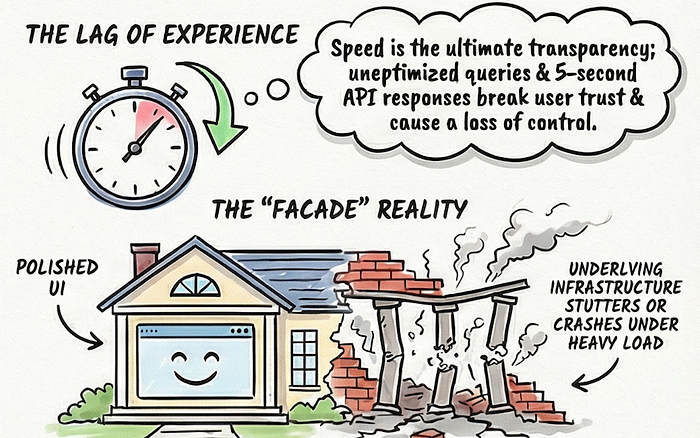
User experience isn't just about where a button is; it's about trust. When a dashboard takes 4 seconds to fill due to an unoptimized SQL query or a bloated microservice load, the user feels a loss of control.
In the world of "Calm Tech," speed is the ultimate transparency. A flawless architecture doesn't shout; it gets out of the user's way.
 AI-generated image
Architecture as a User Experience Constraint
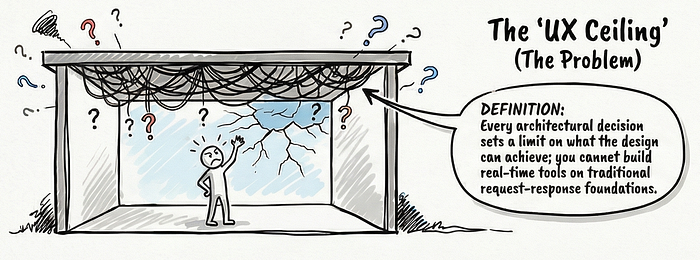
Every architectural decision sets a "UX Ceiling." You can't build a real-time collaboration tool (like Figma or Notion) on a traditional request-response architecture; you're bound to hit a wall.
 AI-generated image
Database Constraints: If your schema is rigid (and let's face it, most legacy schemas are), your "Personalization" features will be limited.
Front-End State Management: If your stack mismanages data, the user interface will stutter and cause cognitive load.
Scalability: If your system gets bogged down at 10,000 concurrent users, your user experience will devolve into "Maintenance Mode" screens.
Filling the Gap: "Product-Oriented" Engineering
The shift from "Software Engineering" to "Product Engineering" happens when we stop asking "How do we build this?" and start asking "How does this architectural choice affect the user flow?"
When we build the Architecture as a Product, we focus on:
- Modular Scalability: Designing components that allow features to evolve without disrupting the user journey.
- Resilient Error Management: Moving away from generic "Error 500" messages to gradual decrements that guide the user.
- Performance as a Feature: Treating 100ms latency improvements with the same priority as a new UI element.
 AI-generated image
The Business Value of Technical Clarity
For global startups and B2B leaders, a clean architecture is the ultimate Time-to-Market accelerator.
When your tech stack is "calm" and well-structured, you don't struggle with code to release a feature; you leverage the code. This agility is what separates market leaders from those who "feature-chasing" laggards.
The Strategic Alignment of Performance
Ultimately, the distinction between a system's backend and its frontend is an internal one; to the user, they are a single, inseparable experience. When a system is architected with product goals in mind, technical constraints evolve into design opportunities. It is no longer about what the code allows, but how the infrastructure empowers the user.
This paradigm shift requires a new approach to product planning. The next time a roadmap session is convened, the focus should extend beyond Figma files and visual prototypes. By examining the system diagram alongside the user flow, teams can identify whether their architecture is truly enabling the vision or acting as an invisible barrier.
 AI-generated image
Architecture is the silent partner of UX. For companies aiming to build resilient, world-class products, it is time to give the technical foundation a permanent seat at the design table.
Does your current tech stack support your long-term design vision? Next time you're in a sprint planning, skip the UI discussion for a moment. Ask your lead architect: "If we 10x our data tomorrow, does this design still hold up?"
Let's continue the conversation. Follow Appibara on LinkedIn, where we regularly share deep dives into product-oriented engineering, architecture, and the realities of scaling SaaS.