
“AI Wrote the Code, Why Am I to Blame?”: The Silent Responsibility Crisis in Software Engineering
AI gave us speed, but destroyed accountability. How to stop “blind approvals” and rebuild a culture of trust in engineering.
 AI generated image
Our story takes place in a fast-growing SaaS company. It's Friday afternoon, and a Senior Developer needs to ship a new data export module before the weekend. Time is running out. The developer prompts their IDE's AI assistant to write an asynchronous service that joins three database tables, applies specific date filters, and exports the data as a CSV without bloating the server memory (using streams).
In seconds, the AI generates a 150-line block of code. It looks flawless on the surface — full of RegEx and complex queries. The Senior Developer runs it locally; the module works perfectly. Taking a deep breath, they submit it as a Pull Request (PR) to go live.
The Reviewer (a teammate) opens the screen. They are faced with 150 lines of dense business logic that is mentally exhausting to parse, yet impeccably formatted. The Reviewer thinks, "The person who submitted this is a senior developer, they must have written and tested it themselves," and, reluctant to read the deep logic line-by-line, clicks the "Approve" button.
Friday night, the code goes live. Saturday morning, the company's servers crash.
Why? The AI-generated code misconfigured the memory management, causing a massive memory leak in the database that completely locked up the system.
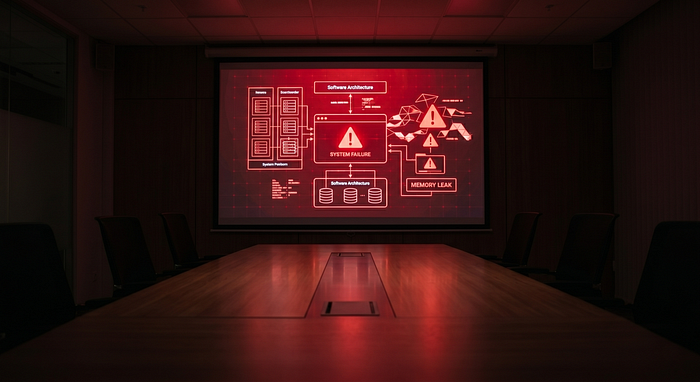 Aı generated image
The Confrontation: Silence in the Post-Mortem Room
Monday morning, in the Post-Mortem meeting, the CTO asks the inevitable question: "Who is responsible for this failure?"
- The Senior Developer defends themselves: "I didn't design the internal logic of that query; the AI generated it. I just hooked up the asynchronous structure to the system, and it worked locally."
- The Reviewer defends themselves: "The code was highly complex. Since it was generated by AI, I assumed the developer who submitted it had already filtered it line by line. I only looked at the general architecture."
The executives in the room realize a bitter truth: Nobody in the company actually read those 150 lines of code. The code came out of a machine, slipped through the cracks of two humans assuming the other had checked it, and struck directly at the heart of the company. In the industry, this is quietly becoming known as a "Blind Approvals"
The Paradigm Shift: Becoming an Editor, Not a Writer
This story is no longer an exception; it is becoming the new industry standard. In the past, a software engineer wrote 100 lines of code a day and felt the responsibility for every single character in their bones. Now, an AI generates 2,000 lines in seconds.
Developers are no longer just "coders"; they have transformed into "code editors" inspecting massive blocks of text. But here is the problem: reading complex business logic written by someone else (or a machine) is cognitively much more exhausting than writing it from scratch.
We need to accept one reality: AI is not a "colleague"; it is simply a tool — a very fast typewriter. The legal, ethical, and architectural responsibility does not belong to the tool, but to the person typing on it.
Rebuilding a Culture of Responsibility
 AI generated image
To overcome this silent crisis, teams building sustainable products must deliberately introduce Meaningful Friction between "Speed" and "Trust." Companies urgently need to integrate these three rules into their engineering culture:
- The Committer Owns It: The phrase "AI wrote this" must be banned in the office. If you push code to the repository, every security vulnerability, every memory leak, and every success in that code belongs 100% to you. Just as the driver is responsible for an accident in a self-driving car on autopilot, the responsibility for the code lies with the person who clicked "Submit."
- The "Explain It to Me" Test: A Code Review is no longer a place just to ask, "Does this work?" When the Reviewer points to a line and asks, "Why did you set up the memory management this way?" the developer cannot say, "I don't know, the AI auto-completed it." Code you cannot defend is not your code, and it should be rejected immediately.
- Humans Write the Tests: Verifying machine-written code with machine-written tests is corporate suicide. If the AI is generating the code, the human mind must personally design the test scenarios (Unit Tests) that push the boundaries of that code.
Building Trust
AI has given us unprecedented speed. However, speed can never replace trust. The successful software teams of the future will not be the ones who generate the most code, but the ones who can take the most transparent responsibility for the code they produce.